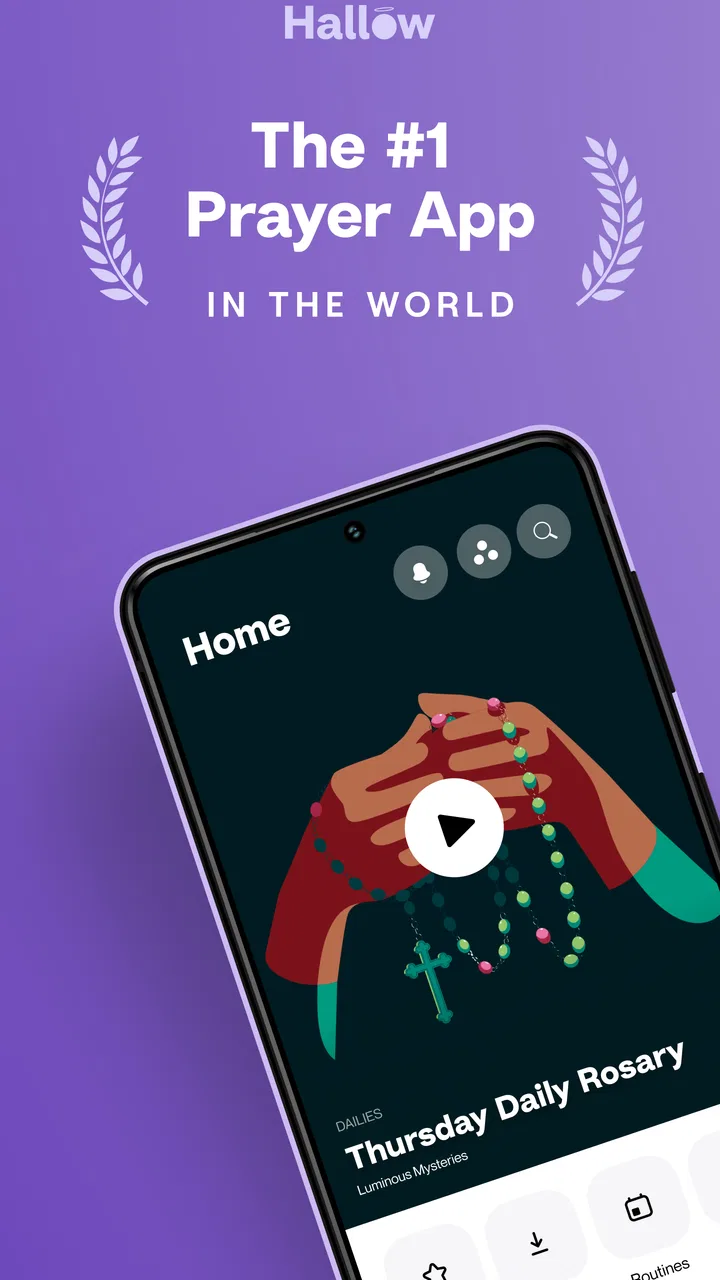
Hallow: Prayer & Meditation
- 4.5
- Rating
- 10.00M
- Installs
- Free
- Price

 Analysis by App-foxy
I approached Hallow: Prayer & Meditation as a practical Catholic prayer companion rather than as a replacement for a Bible, a parish, or personal reflection. Developed by Hallow, Inc., this free Books & Reference app brings prayer sessions, rosary material, Catholic Bible content, and Christian music into one mobile space. I found that combination useful when I wanted a clear starting point instead of searching through several unrelated apps.
The app has a 4.7 average from around 122 thousand ratings, with more than 10 million installs. Those figures suggest that it has reached a broad audience, but popularity is not the same as suitability. My experience is that its real value depends on how comfortable you are with guided audio, a structured devotional routine, and the way a large app organizes spiritual content.
What the app feels like in everyday use
My first impression was that Hallow is designed for people who want prayer to fit into an existing day. It is easy to imagine opening it before work, during a quiet evening, or while taking a walk. Instead of asking me to decide exactly what to read and how long to spend, it presents a more directed path. That can be reassuring when I am distracted or simply do not know where to begin.
You May Also Like

 Blood Strike: 2.5 Anniversary
Blood Strike’s Loadouts Turn Every Drop Into a Tactical Gamble
A close look at Blood Strike’s custom loadouts: how fast access to signature weapons reshapes its battle royale rhythm, rewards preparation, and narrows the gap between fights.

 Pandora - Music & Podcasts
Pandora’s Music Is Easy to Start, but Harder to Recover
Pandora’s strength is its low-effort path from a seed to a station. Its weak spot is how much confidence it asks you to place in connection, setup, and quiet recovery.

 8 Ball Pool
 Is Built on Rivalries, Rematches, and Routine
A close look at the rivalries, rematches, shared routines, and unanswered safety questions that turn a quick pool match into a persistent mobile community.

 Samsung Music
’s Quiet Strength Is Playing What You Already Own
Its reach comes less from spectacle than from dependable access to a personal library. That simplicity is both the app’s strongest retention engine and its ceiling.

 AccuWeather: Weather Radar
AccuWeather Review: A Quick, Clear Forecast for Everyday Decisions
For everyday plans, the best forecast is the one you can understand quickly. AccuWeather makes rain timing, radar, and local conditions easy to act on, with a few trade-offs.

 Hill Climb Racing
Why Hill Climb Racing Still Turns Crashes Into One More Run
A tiny car, a bumpy hill and one more upgrade: Hill Climb Racing keeps resurfacing because its simple chaos makes every near-miss feel personal.
More From Our News Desk



The main focus is not only silent reading. Guided prayer and meditation make the experience feel closer to having an audio companion. This is especially helpful for users who struggle to maintain attention while reading from a screen. Listening also makes the app more practical during a calm household task, although I would avoid using it in situations where concentration is needed elsewhere.
The Catholic identity is clear, which is important before installing it. This is not a general mindfulness tool with a few religious options added later. The rosary, Catholic Bible material, Christian music, and prayer-centered approach give it a specific audience. I would recommend it to Catholics and to Christians who already feel comfortable with Catholic devotional language. Someone looking only for secular breathing exercises or broad wellness content would probably find the focus too narrow.
Hallow is marked for Everyone, and the app is free to install. The free entry point makes it reasonable to explore the basic experience before deciding whether it belongs in a daily routine. At the same time, in-app purchases range from $0.99 to $199.99 per item, so I would pay attention to the purchase screens and avoid assuming that every part of the library is included without charge.
Why the guided format can work better than a loose collection of readings
A traditional Bible app usually excels at searching passages, comparing translations, and reading at your own pace. Hallow serves a different purpose. It is more useful when I want help moving from intention to action: choose a prayer, press play, and give that period my attention. The trade-off is that users who want detailed study tools may prefer a dedicated Bible app or a printed Bible beside a notebook.
The same distinction applies to a standalone rosary app. A simple rosary tool may be faster if I already know exactly which mysteries I want and do not need additional guidance. Hallow becomes more appealing when I want the rosary to sit alongside other forms of prayer and Christian audio rather than remain a single-purpose utility.
I also noticed a practical advantage in keeping different devotional activities together. A person might begin with a short guided prayer, continue with the rosary on another day, and use Christian music when reading. That variety can prevent a routine from becoming stale. The downside is that a broad content library can make choosing feel like another task. My advice is to select one dependable prayer format first instead of browsing indefinitely.
Trust starts with what the app lets me see and control
For a prayer app, trust is not only about the religious material. It is also about whether I understand what I am doing when I create an account, start a subscription, or use the app in private moments. I would treat Hallow with the same care as any other app that may be present during personal reflection: read the sign-in screens, review the choices presented, and check the device settings before settling into regular use.
I do not assume that a calm interface automatically means minimal data collection. The safest approach is to inspect the app’s visible privacy notices and permission prompts on the device where it is installed. If a permission is requested, I would ask whether it is necessary for the way I plan to use Hallow. If I only want to listen to prayer sessions, I would be cautious about granting access that does not appear relevant to that purpose.
Account controls deserve the same attention. Before building a long-term routine, I would look for the available options to manage my account, notifications, purchases, and any saved preferences. This is not busywork. It gives me a clearer idea of how much control I have if I later change phones, stop using the service, or decide that I want fewer reminders.
Because the app includes paid items, I would also distinguish carefully between installing it for free and accessing every part of its content. I prefer to pause at any trial or purchase screen, read the wording, and confirm the billing choice through the platform’s own controls. The listed purchase range is wide enough that this is one area where a few seconds of attention can prevent an unwanted commitment.
Private prayer does not remove the need for privacy awareness
Prayer can involve sensitive subjects: family problems, health worries, grief, guilt, or personal hopes. Even when I am not typing those details into the app, the surrounding context still matters. I would avoid treating any digital prayer service as a private diary unless its current privacy information clearly supports that expectation.
My cautious habit is simple. I do not enter intimate personal details into optional fields unless I understand why they are needed and how they are handled. I also keep notifications discreet if the phone is shared or visible to other people. A reminder that displays a religious phrase on a lock screen may be welcome for one user and uncomfortable for another, so I would review notification previews rather than leaving every default enabled.
Shared devices create another realistic concern. If several family members use the same phone or tablet, I would check which account is active before starting a session or making a purchase. This matters especially in households where children can access the device. The Everyone age rating makes the app broadly accessible, but it does not replace supervision around accounts, payments, or personal listening habits.
I would also be thoughtful about using the app in public. Headphones can make guided prayer feel personal, but the phone itself may still reveal what is open or playing. For a quiet commute, that may be fine. For a workplace or classroom, I would use a discreet notification setup and avoid assuming that other people want to hear the audio.
Useful routines I built around the app
The most effective routine for me was to choose a fixed moment rather than promise to use Hallow whenever I had free time. For example, after turning off my work notifications in the evening, I could open one prayer session and stop there. This reduced the temptation to browse and made the app feel like part of a habit instead of another content feed.
A second useful approach is to match the format to my attention level. When I was mentally tired, guided audio was easier than opening a long reading. When I wanted to think more deeply, I preferred to slow down and use the Catholic Bible material rather than letting the session play in the background. That distinction helped me avoid confusing passive listening with active prayer.
I also found it helpful to keep a non-digital option nearby. A printed Bible, rosary, or notebook can be better when the phone itself is distracting. Hallow is strongest when it removes friction, not when it becomes the only way I pray. If I notice myself checking other notifications between sections, I would switch to airplane mode where appropriate or move to a physical resource.
For families, I would introduce the app as an optional aid rather than a compulsory routine. One person may appreciate guided sessions while another prefers a parish prayer group or quiet reading. The app can support a shared intention, but it should not replace conversation about what each person finds meaningful.
Where the experience may frustrate careful users
The biggest limitation is the tension between convenience and choice. A large selection sounds helpful, but too many possibilities can weaken consistency. I would rather complete one suitable session regularly than spend ten minutes comparing options and then close the app. Users who prefer a very simple interface may find a broader devotional library less direct than a basic rosary or Bible reader.
The audio-led design may also be a poor fit for everyone. Some people pray best in silence, at their own pace, or with a physical book. If a narrator’s rhythm does not suit me, I cannot assume that the content will feel natural simply because the topic is familiar. In that situation, a printed resource or a simpler reading app may be the better choice.
There is also a financial judgment to make. Free installation is a useful invitation to try the service, but the presence of purchases means I would not build my entire routine around content I have not checked for continued access. I would first establish whether the available free material meets my needs. If it does, there is no reason to buy immediately; if it does not, I would compare the cost and commitment with parish resources, books, or another app before paying.
People seeking advanced scripture study should keep their expectations realistic. Hallow’s strength is guided devotion and accessible prayer, not the kind of detailed research workflow that may be central to a scholarly Bible platform. I would choose it for prayer structure, not for extensive cross-referencing, academic notes, or a replacement for formal religious education.
Who should try it, and who should look elsewhere
I think Hallow is a good match for a Catholic who wants help creating a repeatable prayer habit, especially someone who appreciates spoken guidance and wants rosary, Bible, and Christian music content in one place. It can also suit a Christian exploring Catholic devotional practices with an open mind, provided the app’s specific tradition feels appropriate.
I would recommend trying it to a busy person who keeps intending to pray but struggles to begin. A short, guided session can remove the blank-page problem. It may also help someone returning to prayer after a long break, because the app offers a concrete starting point instead of requiring a complete personal plan from day one.
I would not make it my first recommendation for someone who wants secular meditation, a minimalist prayer timer, or a rigorous Bible study tool. It is also not ideal for a user who dislikes audio guidance, does not want to manage account and purchase choices, or prefers all spiritual material to remain offline and independent of a phone.
On the technical side, the current version is 12.17.2 and it requires Android 6.0 or later. That makes it accessible to many older Android devices, though the actual experience can still depend on the phone’s storage, audio setup, and notification behavior. Since it is also available as an iOS-focused product in the wider app context, I would check the relevant platform’s current controls before moving between devices rather than assuming that every account setting behaves identically.
My cautious recommendation
After using Hallow as a prayer companion, I see its strongest quality as guided focus. It gathers Catholic prayer formats and Christian audio in a way that can make a daily pause easier to start. The app feels most worthwhile when I choose a modest routine, keep notifications and permissions intentional, and treat the free installation as a chance to evaluate rather than as a promise that everything is included.
I would recommend it to the right person, not universally. If you want Catholic devotional guidance and appreciate having several formats available, Hallow can be a thoughtful addition to your day. If your priority is silent reading, detailed scripture study, minimal data exposure, or a completely purchase-free experience, a physical Bible, parish resource, or more focused alternative may serve you better.
My final view is positive but deliberate: Hallow is useful when it supports your prayer life without taking control of it. Review the visible account, permission, notification, and payment choices, start with a routine you can actually maintain, and keep another form of prayer available. Used that way, this Books & Reference app feels less like a replacement for faith practice and more like a convenient doorway into it.
FAQs for Hallow: Prayer & Meditation
01What is Hallow: Prayer & Meditation, and how does it work?
Hallow: Prayer & Meditation is an app designed to help users deepen their spiritual life through guided prayers, meditations, and reflections. It offers a variety of content, such as daily prayers, meditative music, and scripture readings. Users can personalize their experience by selecting different themes and durations to fit their spiritual needs.
02Is Hallow suitable for all religious beliefs?
Hallow primarily focuses on Christian teachings, offering resources aligned with Catholic traditions. However, it can be beneficial for anyone interested in Christian spirituality. The prayers and meditations are rooted in scripture, making it a valuable tool for those seeking to explore or deepen their faith through structured guidance.
03What features does Hallow offer to enhance the user experience?
Hallow provides a range of features, including daily reflections, sleep meditations, and a community aspect where users can share intentions and prayers. The app also offers customizable sessions, allowing users to choose the length and focus of their meditations. This flexibility makes it easy to integrate into any schedule or lifestyle.
04Is Hallow available for free, or does it require a subscription?
Hallow offers a free version with limited access to its content. For a more comprehensive experience, users can subscribe to Hallow Plus, which unlocks the full library of meditations, prayers, and exclusive content. The subscription is available on a monthly or annual basis, with a free trial period for new users.
05How can Hallow help improve my daily spiritual practice?
Hallow can enhance your spiritual practice by providing structured guidance through its extensive library of prayers and meditations. It encourages consistency with daily reminders and personalized plans, helping users build a routine. The app's reflective tools and community engagement also support a deeper understanding and connection with one's faith.
Pros
- Wide variety of prayer content available.
- User-friendly interface for easy navigation.
- Daily reminders to help build a habit.
- Offline access for uninterrupted use.
- Calming background music enhances experience.
Cons
- Limited features in the free version.
- Occasional app crashes reported by users.
- Requires a stable internet for updates.
- May consume significant battery life.
- Subscription can be pricey for some users.

Hallow: Prayer & Meditation
Gallery